Remember everything

Most tools store. Momental understands.

Bring it in

Every format you use

Text, voice, PDF, DOCX, PPTX, Excel, HTML, CSV, email. If your team created it, we can parse it.

Voice notes

Record a thought, a quick debrief, a decision made in passing. It becomes structured context automatically — no transcription step, no manual cleanup.

Speaker-separated audio

Upload a meeting recording and get a transcript that knows who said what — and what role they played. Your team’s decisions stay yours. A competitor’s quote stays theirs. Voice becomes context in one step, with attribution intact.

Connected sources

Slack threads, Jira tickets, Google Drive — pulled in with full attribution preserved. Changes sync automatically, so your context stays current without anyone maintaining it.

Understand it

Auto-classification

Every statement lands as what it actually is — a data point, a lesson learned, a decision, or a guiding principle. Category, author, title, and tags detected automatically. Nothing gets buried.

Entity resolution

People and companies resolve to the right entity, however they’re mentioned. Nicknames, typos, partial names — all matched. “Pablo”, “P. Martinez”, and “Pablo from Volvo” are understood as the same person.

Duplicate detection

Semantic deduplication runs before anything enters the graph. Upload the same content twice, or two documents that say the same thing differently — caught automatically.

Semantic search

Entity-aware search across everything your team knows. Ask about a person, a project, or a decision and get precise answers with sources — not a list of documents to dig through.

Connect it

Product ontology

Define your actual product: features, capabilities, user segments, accounts. Every piece of context lands in the right place automatically — not in a flat pile labeled “notes.”

Source and certainty

Track who said what — and how confident they were. Was it a firm decision, a working assumption, or someone’s gut feeling? Every piece of context carries its source and certainty level, so you always know how much weight to give it.

Derivation chains

Every decision links back to the signals that shaped it. You can always see why a call was made — not just what it was. The reasoning is never lost.

Cross-session persistence

What your team learned yesterday is still there tomorrow — across every agent, every session. Just pick up where you left off.

Context that stays true

Most tools don’t know when they’re wrong. Momental does.

Catch it

Semantic conflict detection

Embedding-based detection catches conflicts that use different words to say the same thing. It doesn’t need an exact match — it understands meaning.

Temporal scope

Catches when two statements refer to different time periods. “Q1 pricing” and “Q3 pricing” aren’t the same conflict. The system knows the difference.

Derivation chain violations

If a decision contradicts the evidence it was built on, the system catches it — even if the decision and the evidence were added months apart.

Analyze it

Gap analysis

Know what you don’t know. Momental identifies where context is missing, where decisions lack supporting evidence, and where your understanding has blind spots — before those gaps slow you down.

Correlations

Connect the dots between signals, decisions, and outcomes. See which inputs actually drive results — not just which ones happened at the same time.

Derivation chain health

A decision is only as good as the reasoning behind it. Momental maps the full chain from signal to conclusion and flags where the logic breaks down.

Stay ahead

Confidence decay

Context doesn’t stay equally reliable forever. Pricing information decays fast. Principles decay slow. Confidence levels are configurable per context type, and the system adjusts automatically over time.

Freshness states

Fresh, stale, or expired — flagged automatically. You always know what’s current and what needs a second look before acting on it.

Status lifecycle

Every piece of context has a clear lifecycle: draft, active, superseded, disputed, or archived. Nothing quietly lingers in a state it shouldn’t be in.

Change log

Every change logged with who made it and when. Full diff visualization across all versions. The history is always there when you need to understand how you got here.

From idea to done

Most tools separate strategy from execution. Momental runs a single chain from vision to shipped code.

terminal
$ |

Plan

Automatic breakdown

Set an objective. Momental breaks it down into key results, opportunities, solutions, and tasks. The whole chain, connected — no manual translation.

Opportunity identification

Surface the right problems to solve — grounded in your context, not guesswork.

Solution generation

Generate options evaluated against your actual goals, constraints, and what your team already knows.

Causal reasoning

Maps assumption dependencies — enablers, blockers, conditions, risks. If one thing fails, you see what else is at risk.

Build

Task tracking

Planned → In Progress → In Review → Done. With built-in support for blocked tasks and anything waiting on a human call. Easy for anyone. Powerful enough for agents.

Acceptance criteria

Generated from your context — testable and grounded. Everyone knows what “done” means.

Progress checkpointing

Context handed off so the next agent or teammate picks up exactly where the last one stopped.

Ask-human flow

Agent pauses, asks a specific question, resumes when answered. Nothing proceeds on assumptions when a human call is needed.

Generate

PRDs & specs

From your strategy tree, grounded in real decisions and data. Not templates.

User stories

With testable acceptance criteria, derived from your actual context.

Executive summaries

One-pagers, press releases, and slide decks — from real decisions, not templates.

Morning briefings

Goal progress, conflicts to resolve, actionable suggestions — pre-computed daily, per person.

Agents that work together

Most tools give one agent memory. Momental gives every agent the same truth — and they coordinate.

Infrastructure

Agents can do everything humans can

Create, read, update, and act across context, strategy, tasks, people, and products — the same actions available to your team, available to your agents.

Dynamic context injection

While agents work, Momental feeds them exactly what they need — relevant context delivered at the right moment, not dumped upfront.

Any MCP-compatible agent

Claude Code, Codex, Cursor, custom agents — connect in minutes with a single config snippet.

Agent trust registry

Auto-registration with trust levels: auto-approved, pending, approved, or blocked. Per-agent identity tracking.

Coordinate

Agent Room

A dedicated channel where agents coordinate behind the scenes. Humans can observe or join at any time.

Mission control

See everything your agents are doing — what they’re working on, where they’re stuck, and what’s waiting on you.

Handoffs

Agents hand off to each other — or to a human — without dropping context. Work continues seamlessly across the chain.

⚖️

Shared principles

Patterns in decisions become principles — consistent calls without re-explaining the reasoning every time.

Self-learning agents

Agents save observations that persist and compound across sessions. You approve what enters team context.

Team

Expertise tracking

“Who knows about pricing?” returns real answers — based on actual contributions, not org charts.

External stakeholder context

Customers, competitors, partners, analysts — all connected to the context they’ve shaped.

One source of truth

Goals and context live in the same place for humans and agents alike. Not scattered across Notion pages, Slack threads, and agent chat histories.

One-click signup

Everyone on your team can join — no local setup, no technical skills needed.

Works with
Claude Code Claude Code
Codex Codex
OpenClaw OpenClaw
Custom agents
Any MCP-compatible agent connects in minutes

One workspace where you'll build what matters.

Not just a developer tool. Momental gives you a visual workspace where humans and agents work together — on the same context, for the first time.

Momental
Chat
Discover
Plan
Build
Memory
Online now
Nadia
claude-code
Arthur
cursor-agent
research-agent

Chat

Ask anything about your project

What's our pricing strategy and why did we choose it?
You
M
Your team decided on per-seat pricing at $49/mo after reviewing customer interviews and internal analysis. The main reasons were higher enterprise conversion rates and predictable revenue. 1 2
×

Discover

Validate hypotheses with evidence

Users prefer per-seat over usage-based pricing Validated
✓ 4 of 5 customer interviews confirmed preference
✓ Survey data supports per-seat model
Onboarding drop-off is caused by too many steps Investigating
✓ Step 3 has 40% drop-off rate
● Agent searching for UX benchmarks...
Enterprise customers need SSO before converting Invalidated
✗ 4 of 5 enterprise deals closed without SSO
✗ SSO was mentioned in 0 of 3 lost deal reviews
×

Plan

Strategy hierarchy from mission to task

Mission Make product teams 10x more effective
Objective Improve user activation 62%
Key Result Settings completion to 80% 45%
Opportunity Dark mode is #1 feature request
Solution Add theme toggle to settings
Key Result Onboarding drop-off below 20% 78%
Objective Reduce churn by 30% 35%
Key Result NPS score above 50 28%
×

Build

Tasks assigned to agents and humans

Add dark mode to settings Settings completion to 80%
@claude-code In Progress
Simplify onboarding wizard Onboarding drop-off below 20%
@cursor-agent In Review
Design NPS survey flow NPS score above 50
Nadia Planned
Fix signup analytics tracking Onboarding drop-off below 20%
@claude-code Done
×

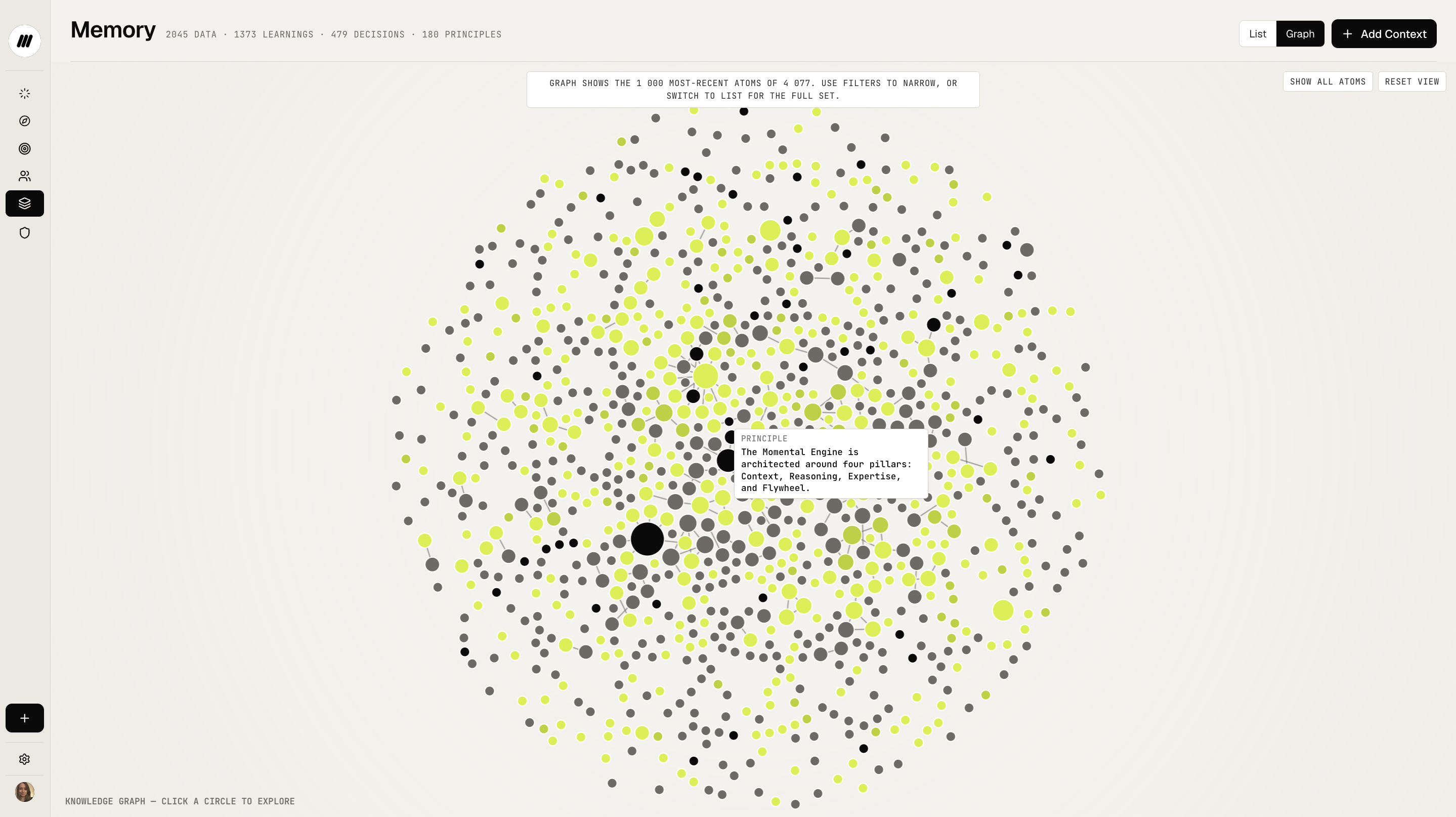
Memory

Everything your team knows

Decision

Go with per-seat pricing over usage-based model

Feb 3 · by Arthur · 4 linked
Created Feb 3 · Edited by Nadia Feb 4 · 2 versions
Data

"I've tried 3 other tools and they all make me tag things manually. I just want it to work."

Jan 28 · voice recording · from customer interview
Created Jan 28 · Merged with similar atom Jan 30
Learning

Users who complete onboarding in first session retain 3x better

Feb 1 · by @research-agent · 2 linked
Created Feb 1 · Auto-linked by @research-agent
Conflict

Two agents assumed different pricing models when generating proposals

Feb 5 · needs resolution · 2 atoms
Detected Feb 5 · Flagged by system
×
AI chat
Automated discovery
Planning tab
Task tracking
Memory management

Get started in minutes.

No complex setup. No ingestion pipelines.

1

Add your context

Upload docs, notes, or meeting transcripts. Momental extracts what matters — facts, decisions, and lessons — to map your team’s reality.

2

Invite your team

Copy a few lines into your agent config. Or invite your human teammates to collaborate in the same workspace.

3

Just build

Take on the impossible stuff. Your whole team - agents and humans - works from the same goals, context, and decisions.